Reusable plastic containers are handled repeatedly throughout warehouses, distribution centres and return-transport networks. During those cycles, a container may be dropped while empty, mishandled during loading or exposed to a sudden impact while carrying goods. For buyers, the important question is not simply whether a container looks strong. It is how the body, corners, rim and attached lids respond under the conditions shown.
KEYUN recorded two practical drop demonstrations using an attached lid container. In the first, an empty container was dropped from approximately 10 metres. In the second, a container carrying a 25 kg load was dropped from 1.5 metres. After each demonstration, no visible cracking, lid separation or immediate functional failure was observed.
These demonstrations provide useful visual evidence, but they are not a substitute for a documented laboratory programme or third-party certification. Results can vary with container size, resin formulation, temperature, load distribution, impact surface, drop orientation and previous service history.
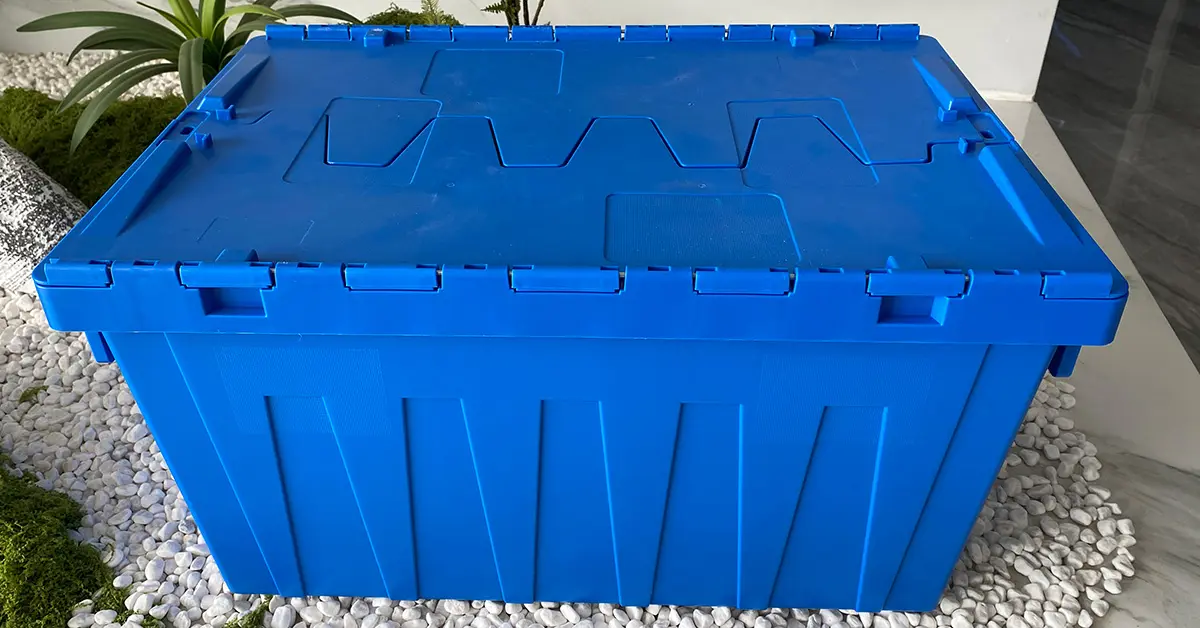
Drop Test Overview
| Test Condition | Drop Height | Observation After the Demonstration |
|---|---|---|
| Empty attached lid container | Approximately 10 m | No visible major cracking, lid separation, or immediate functional failure was observed. |
| Attached lid container with a 25 kg load | 1.5 m | No visible cracking, lid separation, or immediate functional failure was observed. |
These observations apply only to the demonstrated samples and conditions shown. They do not represent third-party certification or a universal drop rating.
The two demonstrations examine different handling risks. The empty drop creates a severe impact after a long fall, while the loaded drop shows how the container responds when the contents add mass and internal force. The results should be read separately rather than treated as equivalent tests.
Demonstration 1 — Empty Container Drop from Approximately 10 Metres
The first video shows an empty attached lid container released from a height of approximately 10 metres. This is more severe than an ordinary manual-handling drop and gives viewers a clear look at how the container responds to a high-impact event.
After the drop, no visible major cracking, detached lid panel or immediate loss of function was observed. The footage is useful because it records the event directly instead of relying only on a written durability claim.
What to look for while watching:
- deformation around the impact corner or base;
- separation at the hinged lid connection;
- cracking around handles, ribs and rim edges;
- whether the lids can still open and close after impact;
- whether the empty container still sits normally on a flat surface.
Demonstration 2 — 25 kg Loaded Drop from 1.5 Metres
The second demonstration uses a different and highly relevant warehouse scenario: an attached lid container carrying a 25 kg load is dropped from 1.5 metres. A loaded drop places stress on both the external structure and the areas where the contents transfer force into the base and sidewalls.
After the demonstration, no visible cracking, lid separation or immediate functional failure was observed. The result indicates that the tested container withstood this particular loaded-drop event under the conditions shown.
The result should not be interpreted as a universal 25 kg drop rating for every container, load type or impact surface. Dense metal parts, sharp components, liquids and unevenly distributed goods can create very different internal forces. Buyers should match the container and any inserts or dunnage to the actual contents.
Why Impact Performance Matters in Reusable Logistics
Reusable containers move through many handling points: picking, packing, staging, loading, vehicle transport, unloading and empty return. A single-use package may complete one journey, but a returnable container is expected to repeat the cycle. Small weaknesses can therefore become more important over time.
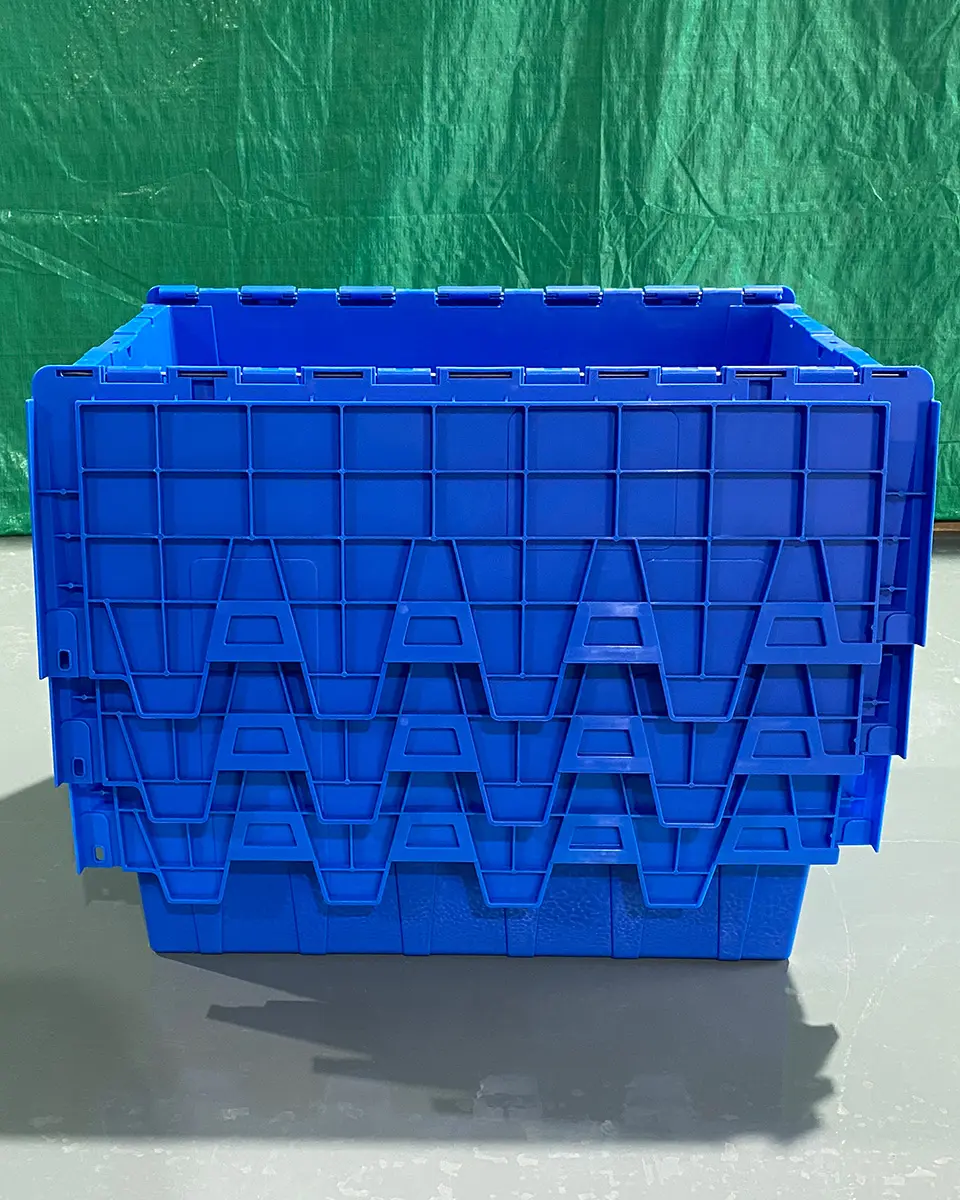
An impact-resistant design can help reduce interruptions caused by cracked walls, damaged rims or detached lids. Permanently attached, interlocking lids also remove the need to manage separate covers. When closed, the lids protect the contents and support organised stacking; when open, tapered containers can nest to reduce empty return volume.
Terminology differs by market. North American buyers may call this product an “attached lid tote” or “reusable plastic tote.” UK and European procurement teams commonly use “attached lid container” and may place it within returnable transit packaging. In Singapore and other English-language Southeast Asian sourcing contexts, “plastic crate with lid” and “industrial plastic container” are also familiar terms. The construction and application should always be checked rather than relying on the name alone.
Post-Impact Inspection Checklist
A container should be inspected after a serious impact even when it appears intact at first glance. Use a consistent inspection process before returning it to service.
1. Check the corners and base
Look for hairline cracks, whitening, deep gouges or permanent deformation around the impact area. Place the container on a level surface and check whether it rocks or sits unevenly.
2. Inspect the rim and stacking surfaces
Confirm that the upper rim remains straight and that the locating surfaces have not been crushed. Damaged stacking geometry can affect stability even when the sidewalls remain intact.
3. Operate both attached lids
Open and close each lid panel. Check the hinges, interlocking edges and contact points. The lids should move normally and meet without excessive force or misalignment.
4. Inspect the handholds and structural ribs
Examine high-stress areas around the handles and molded ribs. Damage in these locations can become more serious during repeated lifting.
5. Review the contents and internal protection
A container can survive an impact while the goods inside are damaged. Check the product, dividers, inserts or dunnage separately. Adjust load distribution and internal protection where necessary.
Caption: Inspect the base, corners, rim, hinges and attached lids before returning a dropped container to service.
The demonstration video also includes a post-impact visual inspection of the container body, corners, rim, hinges and attached lids. Buyers should repeat these checks before returning any dropped container to service.
What These Demonstrations Show — and What They Do Not
The videos show the visible performance of the tested attached lid container during two real demonstrations. They support a practical discussion about durability and give buyers more information than a product photograph alone.
They do not prove that every container will survive every drop. They do not establish compliance with a specific test standard unless the test method, conditioning, sample count, equipment and acceptance criteria are documented against that standard. They also do not replace application testing with the buyer’s real goods.
For a sourcing project, ask the supplier to confirm the container dimensions, material, stated load guidance, stacking arrangement, lid design and expected operating temperature. If the contents are valuable, fragile or unusually dense, request a sample and conduct a controlled trial that reflects the real route.
Choosing an Attached Lid Container for Your Operation
Start with the complete handling system rather than external dimensions alone. Consider:
- the dimensions and weight of the contents;
- expected manual and mechanical handling points;
- stacking height and storage conditions;
- vehicle vibration and return frequency;
- ambient and cold-temperature exposure;
- compatibility with conveyors, dollies and storage equipment;
- identification needs such as colour, labels or logos;
- cleaning, inspection and retirement procedures.
Explore the full KEYUN Attached Lid Containers range:
https://keyunltd.com/attached-lid-containers/
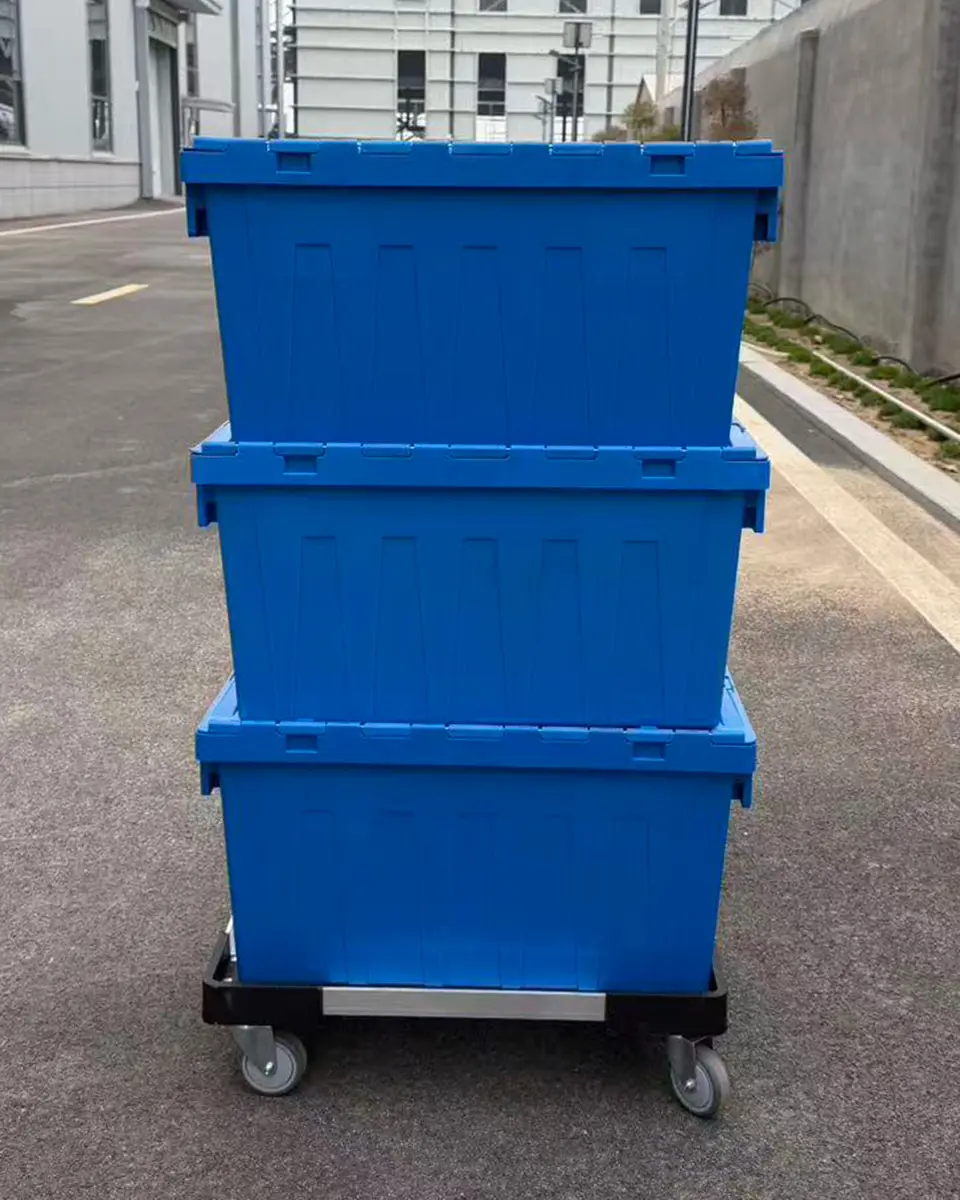
For compatible mobile handling, see Crate Dollies:
https://keyunltd.com/crate-dollies/
Discuss Your Handling Requirements with KEYUN
Tell us the required dimensions, contents, loaded weight, stacking conditions, annual quantity and transport route. KEYUN can help identify a suitable attached lid container and discuss samples, custom colours, logos and project-specific requirements.
Frequently Asked Questions
What is a reusable plastic container drop test?
A drop test observes how a container and its closures respond when released from a defined height under stated conditions. The result depends on the container, load, temperature, surface, orientation and test method, so those conditions should be reported with the result.
Did the empty container survive the 10 metre drop?
In the practical demonstration shown, an empty attached lid container was dropped from approximately 10 metres. Afterward, no visible major cracking, lid separation or immediate functional failure was observed. This observation applies to the demonstrated sample and conditions, not every possible use.
What happened when the container was dropped with 25 kg inside?
In a separate demonstration, an attached lid container carrying a 25 kg load was dropped from 1.5 metres. No visible cracking, lid separation or immediate functional failure was observed after the event. Load shape and distribution can affect results.
Is an attached lid container the same as an attached lid tote?
The terms often describe the same general product type. “Attached lid tote” is common in North America, while “attached lid container” is widely used in international and UK-facing procurement. Some Southeast Asian buyers also search for a “plastic crate with lid” or “industrial plastic container.” Always compare dimensions, construction and load guidance.
Are these demonstrations a certification test?
No. They are practical visual demonstrations under the conditions shown. A certification claim requires a defined standard, controlled procedure, documented sample preparation and formal acceptance criteria.
Can I request a sample for my own application test?
Yes. Provide your required dimensions, contents, loaded weight, handling route and estimated quantity when requesting a sample or quotation. Application-specific testing is especially important for fragile, dense or high-value goods.