Stackable and nestable containers use two different positions to solve two different logistics problems.
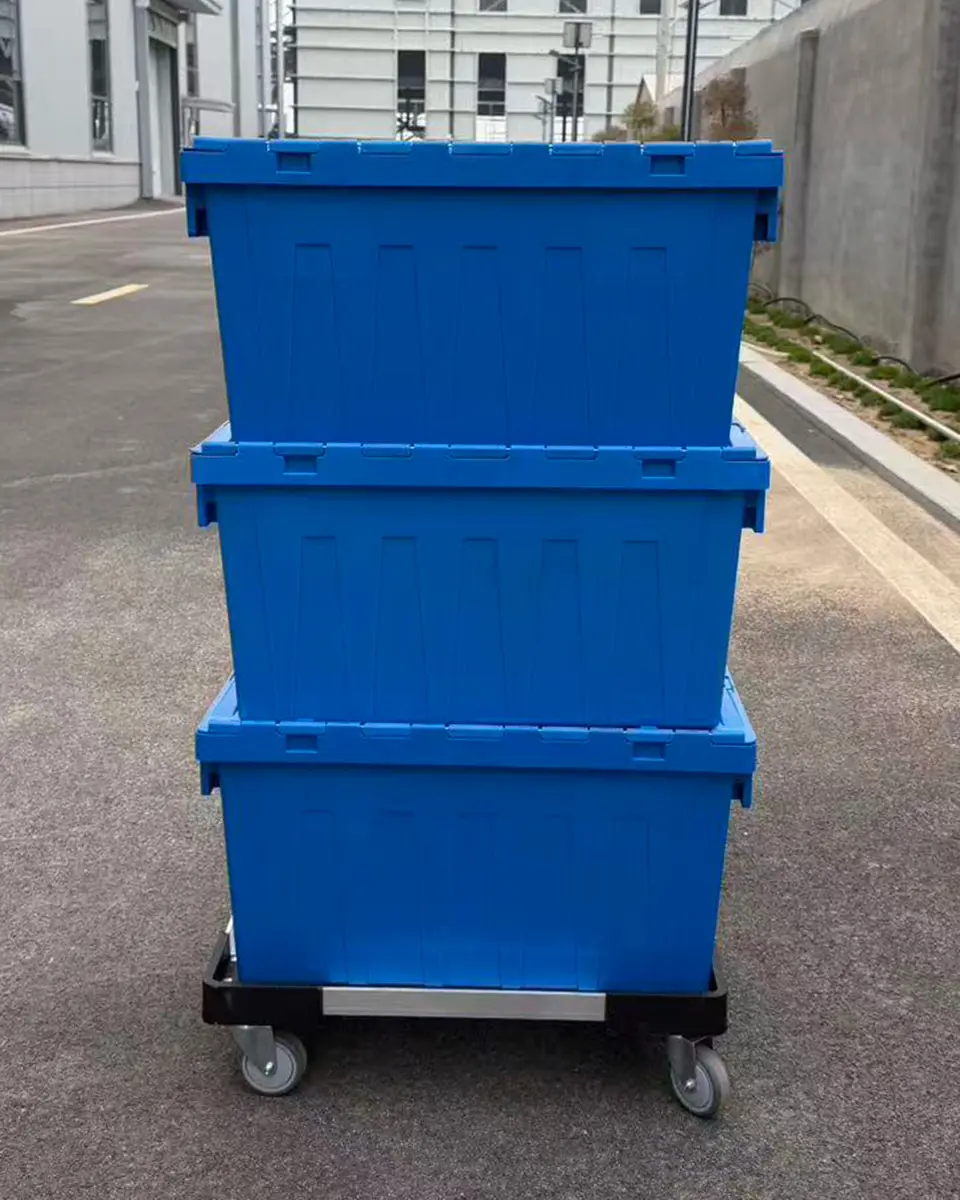
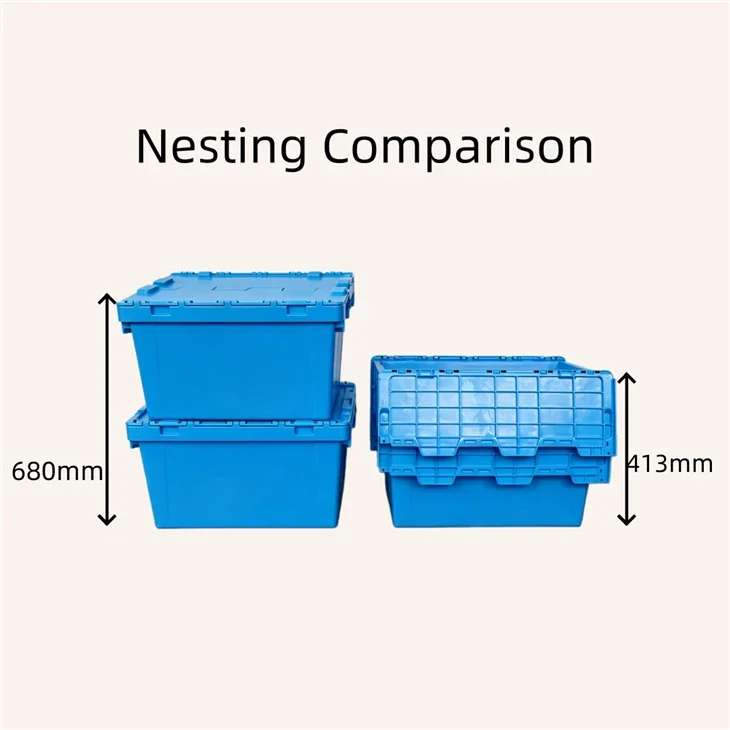
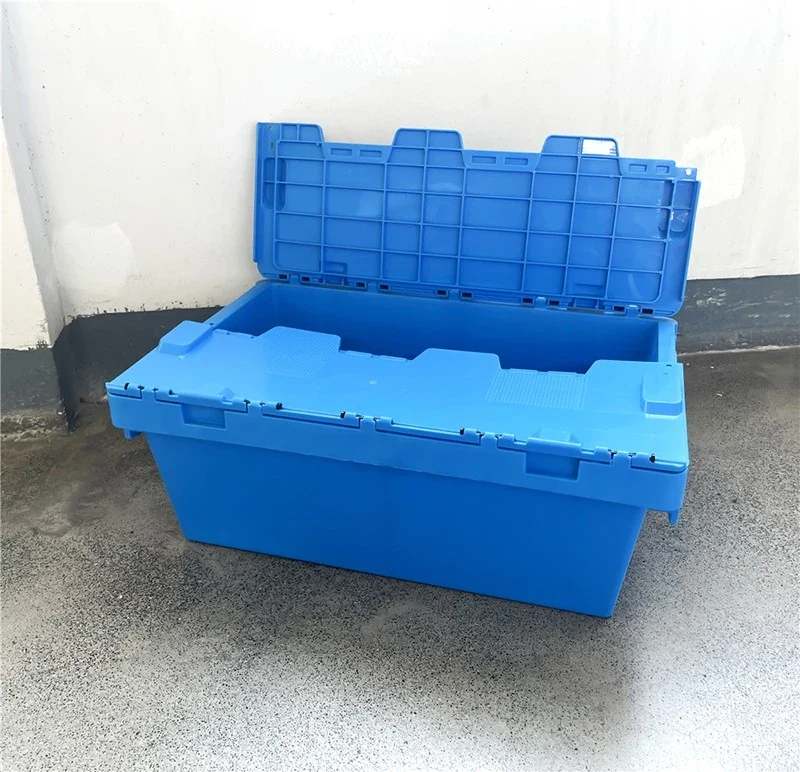
When the container is loaded and its two opposing attached lids are closed, the base and lid geometry allow compatible units to stack. When the container is empty and the lids are opened, the tapered body allows one unit to nest inside another.
This combination supports protected handling during delivery while improving space utilization during empty storage and return transport.
The category is often described using terms such as stack-and-nest containers, attached-lid containers, attached-lid totes, nestable plastic containers, or reusable distribution containers.
Although these terms overlap, buyers should always confirm the actual container design and operating mechanism. A suitable container should be evaluated as part of the complete logistics system, including the contents, lid operation, stacking pattern, empty nesting, handling equipment, identification, cleaning requirements, and return flow.
The Stack-and-Nest Mechanism Explained
Loaded Mode: Lids Closed and Containers Stacked
In loaded mode, the two attached lid panels close from opposite sides of the container and meet at the center.
The closed top helps contain the load and provides the intended surface for another compatible container to sit above it. The container body, lid features, and base must align correctly.
A lid that is not fully closed or a mixed stack of incompatible models can create an unstable stacking condition.
Empty Mode: Lids Open and Containers Nested
After the goods are removed, the lids remain open and the tapered container body enters the container below.
Each nested unit adds less height than a full rigid container, allowing the empty stack to occupy less space during storage and return transportation.
This is different from a collapsible crate. A collapsible crate reduces empty volume by folding its walls, while a stackable and nestable container reduces empty volume by allowing empty containers to telescope into one another.
Why Businesses Choose This Container Format
One Container Supports Outbound and Return Logistics
The loaded stack uses the container’s full height with the attached lids closed, while the empty return uses the nested position.
This allows the same reusable container to support picking, delivery, collection, empty return, and reuse without requiring folding wall panels.
For operations that value a straightforward open–fill–close–stack workflow, stackable and nestable containers can provide a practical solution.
Attached Lids Stay With the Container
Because the lids are permanently connected to the container body, operators do not need to manage separate loose lids.
This can simplify handling and reduce the risk of containers arriving at filling or packing stations without their covers.
The hinges and lid structure should still be inspected regularly because these components experience repeated movement and may be affected by impact, overfilling, or incorrect stacking.
A Consistent Footprint Can Support Standardization
When compatible containers from the same product family are used throughout a logistics loop, their consistent footprint can support standardized pallet patterns, rack positions, picking locations, and compatible dollies.
Standardization can also simplify operator training and visual management.
However, buyers should confirm compatibility before mixing different container sizes, models, or generations within the same stack.
Typical B2B Applications
Retail and Store Replenishment
Stackable and nestable containers can support repeatable movement of goods between distribution centers and retail locations.
Loaded containers can be stacked for transportation and handling, while empty containers can be nested before returning to the distribution center, helping reduce the space required for reverse logistics.
Automotive and Industrial Parts Distribution
Manufacturers and suppliers can use reusable stack-and-nest containers for repeated movement of components between suppliers, production facilities, warehouses, and line-side locations.
Container dimensions, load requirements, internal protection, and handling methods should be evaluated according to the actual components being transported.
Electronics and Component Handling
Stackable and nestable containers can also be considered for electronics and component distribution when the selected container and any internal inserts meet the required protection standards.
For sensitive components, buyers should verify whether additional trays, dividers, dunnage, or static-control solutions are required.
Food and Fresh Product Distribution
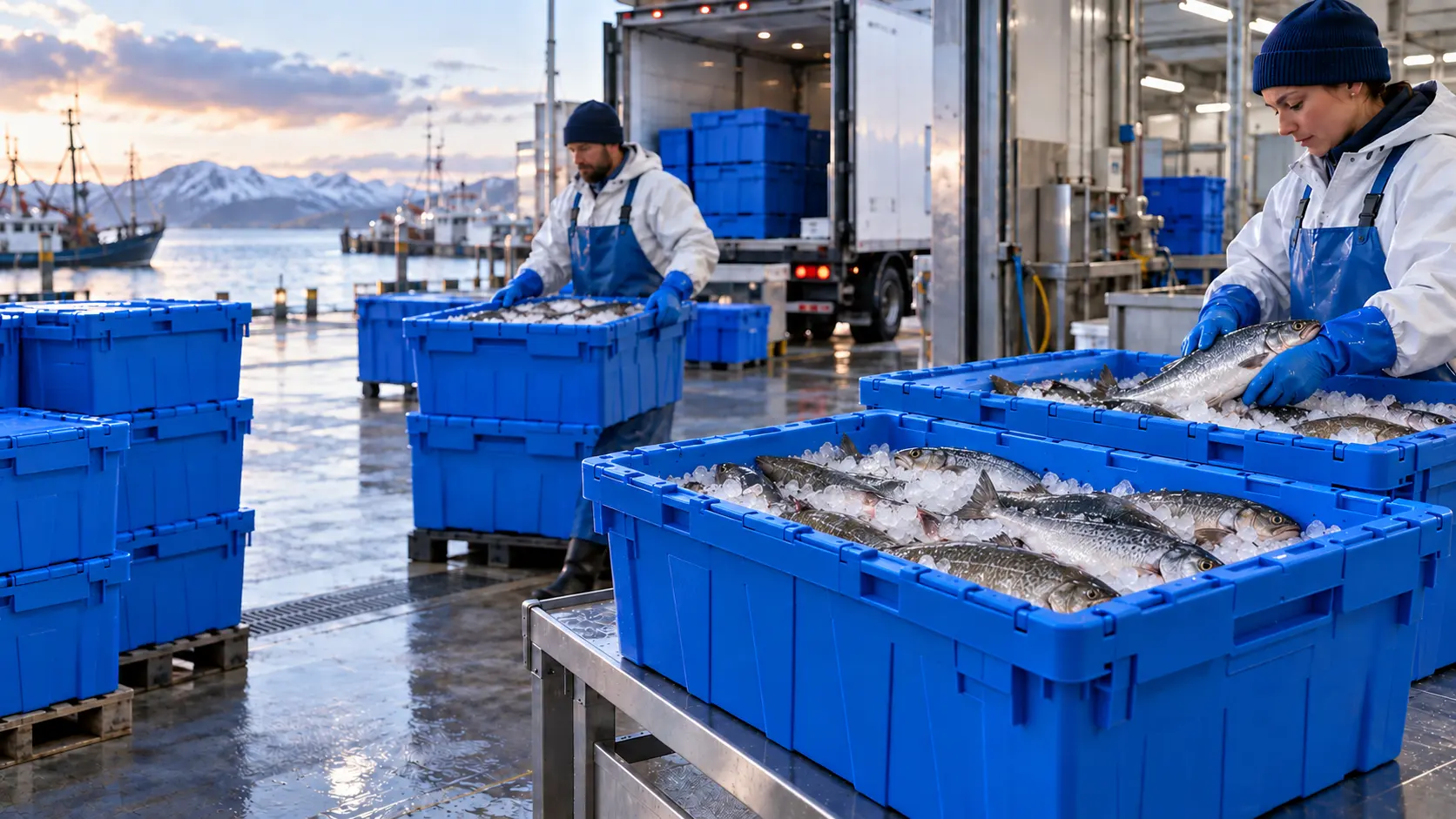
Reusable containers may be suitable for certain food and fresh-product distribution applications.
However, cleaning methods, temperature conditions, material requirements, drainage, contact requirements, and applicable compliance requirements should always be confirmed for the specific container model and application.
Warehouse Picking and Closed-Loop Distribution
Stack-and-nest containers are particularly relevant to closed-loop logistics systems where containers can be collected and returned after delivery.
They can support warehouse picking, internal material movement, distribution, empty return, and repeated reuse within a controlled logistics network.
Benefits Buyers Should Test in the Real Workflow
Before selecting a container, buyers should evaluate its performance under actual operating conditions.
Nesting Efficiency
Compare the height of the empty nested stack and determine how many containers can fit within the available return or storage space.
Stack Stability
Verify lid closure, base engagement, stack alignment, and the effect of the actual load distribution.
Handling Speed
Observe how operators open, fill, close, label, empty, and nest the containers during normal operations.
Load Protection
Determine whether the container body, lid closure, and any internal dunnage provide appropriate protection for the goods.
Asset Identification
Evaluate whether colors, labels, logo areas, barcodes, RFID, or other identification methods are required for the project.
Selection Considerations for B2B Procurement
Usable Dimensions and Taper
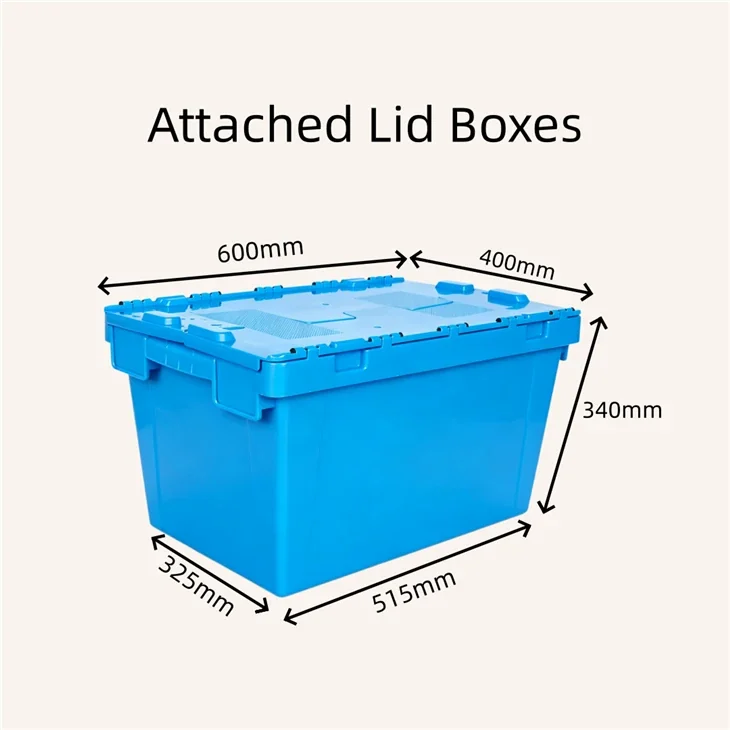
A nestable container typically uses a tapered body, which means its internal dimensions may differ between the top and bottom.
Buyers should request usable internal dimensions at the points that matter for their products.
Components that fit near the opening may not fit correctly at the base of the container.
Before purchasing, confirm product orientation, quantity per container, required usable space, and whether dividers, trays, bags, or other internal packaging will be added.
Lid Geometry, Hinge Configuration and Closure
Inspect how the two lid panels meet, how the hinges are retained, and whether the goods interfere with proper lid closure.
Available hinge configurations may vary between models, so the exact design should be confirmed for the specific project.
Operators should also be able to open and close the lids efficiently during normal handling.
Stacking Under the Actual Load
The word “stackable” should not be treated as a universal load guarantee.
Buyers should define the maximum product weight per container, expected stack height, storage duration, floor conditions, and whether loaded stacks will be transported.
Model-specific stacking and load information should be confirmed before purchasing, followed by testing under the intended operating conditions.
Load distribution also matters. Concentrated components may behave differently from evenly distributed goods.
Nesting Ratio and Separation
A dense nested stack saves space only when operators can separate the containers efficiently.
Check the nested height increment, hand access, release points, and whether labels or debris could interfere with separation.
A safe maximum empty-stack height should also be established for manual handling and transportation.
Cleaning, Drainage and Industry Requirements
Review the container’s corners, hinge areas, ribs, and the spaces between nested containers.
Buyers should consider how containers will be cleaned, dried, inspected, and returned to service.
Food, medical, electronics, and cold-chain applications may have different requirements relating to cleanliness, material, temperature, static control, and documentation.
These requirements should be confirmed for the specific application rather than assumed from the product category alone.
Compatibility With Pallets, Conveyors and Dollies
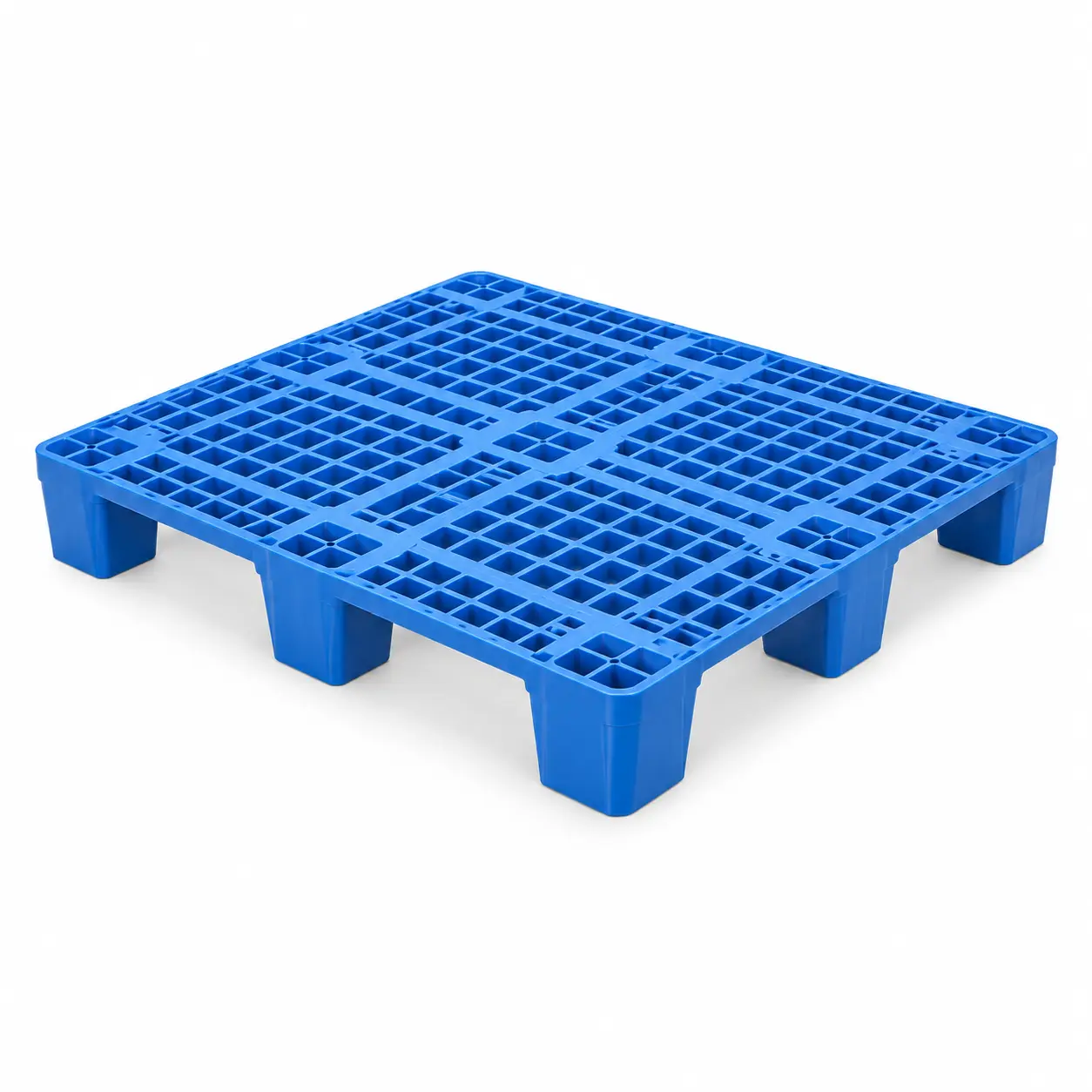
Container compatibility with existing material-handling equipment should be verified before purchasing.
Measure the container base and the surfaces that contact pallets, conveyors, or dollies.
A compatible footprint can improve handling stability, but compatibility should be confirmed rather than estimated.
For conveyor applications, buyers should also evaluate bottom geometry, transitions, sensors, and accumulation behavior through controlled testing.
Common Buying Mistakes
When sourcing stackable and nestable containers, avoid these common mistakes:
- Comparing only external dimensions while ignoring usable internal space created by tapered walls.
- Assuming visually similar attached-lid containers can automatically be stacked together.
- Selecting containers based only on nominal capacity without testing actual product orientation and fill level.
- Ignoring empty-stack separation, cleaning, and label management during the return cycle.
- Using generic load figures without confirming the exact model, load distribution, and intended stacking conditions.
A Practical Trial Plan
Before placing a larger order, B2B buyers can use the following process to evaluate a container:
- Provide the supplier with product dimensions, weight, quantity per container, transportation route, and handling equipment.
- Confirm usable internal dimensions and place actual products or representative samples inside the container.
- Close both attached lid panels and verify proper closure, available labeling areas, and stack engagement.
- Build a controlled loaded stack and evaluate stability under the intended storage or transportation conditions.
- Empty and nest the containers, then evaluate nested stack height, separation effort, and return-space utilization.
- Review cleaning, inspection, identification, and damaged-container handling procedures before final approval.
Frequently Asked Questions
What Is the Difference Between Stacking and Nesting?
Stacking places one compatible loaded container on another in its normal operating position, typically with the attached lids closed.
Nesting places empty tapered containers inside one another with the lids open, reducing the total height and space required by the empty stack.
Are Attached-Lid Containers the Same as Collapsible Crates?
No.
Attached-lid stack-and-nest containers reduce empty volume by nesting one container inside another.
Collapsible plastic crates reduce empty volume by folding their walls.
The better option depends on the goods being handled, workflow, load protection requirements, cleaning process, empty-return requirements, and operator preferences.
Can Different Container Sizes Be Stacked Together?
Do not assume that different sizes or models are stack-compatible.
Stacking compatibility depends on the exact geometry of the container base and lid. Buyers should only use combinations confirmed by the supplier and validated under the intended operating conditions.
Can Stackable and Nestable Containers Be Customized?
Depending on the selected model and project requirements, customization may include options such as colors, logos, labels, barcodes, or other identification methods.
Available customization options should be confirmed for the specific model and order requirements before finalizing artwork or identification methods.
What Information Should I Include in an RFQ?
For a more accurate product recommendation and quotation, provide as much information as possible, including:
- Product dimensions
- Product weight
- Quantity per container
- Required usable internal space
- Expected stacking height
- Storage and transportation conditions
- Empty-return requirements
- Pallet or dolly dimensions
- Cleaning requirements
- Operating environment
- Logo or identification requirements
- Estimated order quantity
Buyers should also request the relevant drawings and model-specific technical information before final approval.
Choose the Right Stack-and-Nest Container for Your Logistics Loop
A stackable and nestable container should be evaluated in two different operating conditions: first as a loaded shipping and storage container, and then as an empty return asset.
The right container should fit the goods correctly, close securely, stack predictably, separate efficiently after nesting, and integrate with the material-handling equipment already used in the operation.
If you are evaluating stackable and nestable containers for warehousing, distribution, manufacturing, retail replenishment, or closed-loop logistics, explore KEYUN’s available solutions or contact our team with your required dimensions, load, application, handling equipment, and estimated order quantity.